"Principle without practice is useless but practice without principle
is dangerous." (Old Japanese Saying)
"This means devising and implementing a programme for convergence at equitable
and sustainable par values for consumption of fossil fuel on a per capita
basis globally." (Indian Environment Minister - COP1)
Related pages
At the Second World Climate Conference in 1990, GCI presented an agenda for solving the global crisis of climate change. This was essentially the proposition of "Equity for Survival". We argued that whilst the traditional proposition of equity for its own sake was a dream, unless the new and more rigorous proposition of equity for survival was adopted, the nightmare of global climate destabilisation would follow.
Limits to growth - certainly of fossil fuel consumption - must now be observed if we are to avoid this climate crisis. Until now however, the limits-free expectations encouraged by the success of laissez-faire economics have been obscuring this. It will be impossible to observe these limits unless, from now on, implementation is internationally configured in a way which corrects the skewed distribution between the rich and poor . This converts a merely moral dilemma into a moral imperative. Because everyone - regardless of status - is now increasingly vulnerable to the impacts of climate change, the rich have little choice but to share the burden of contraction fairly.
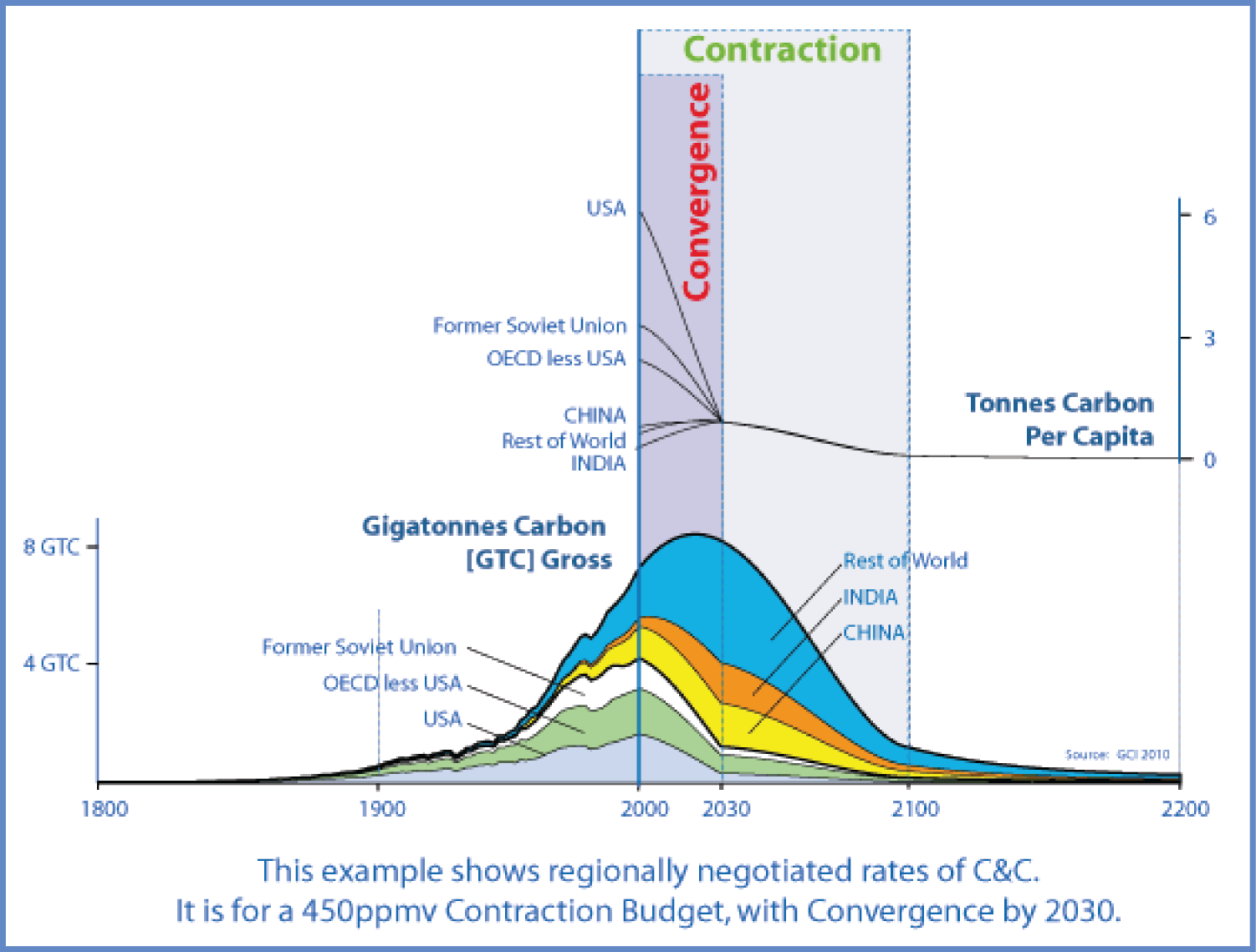
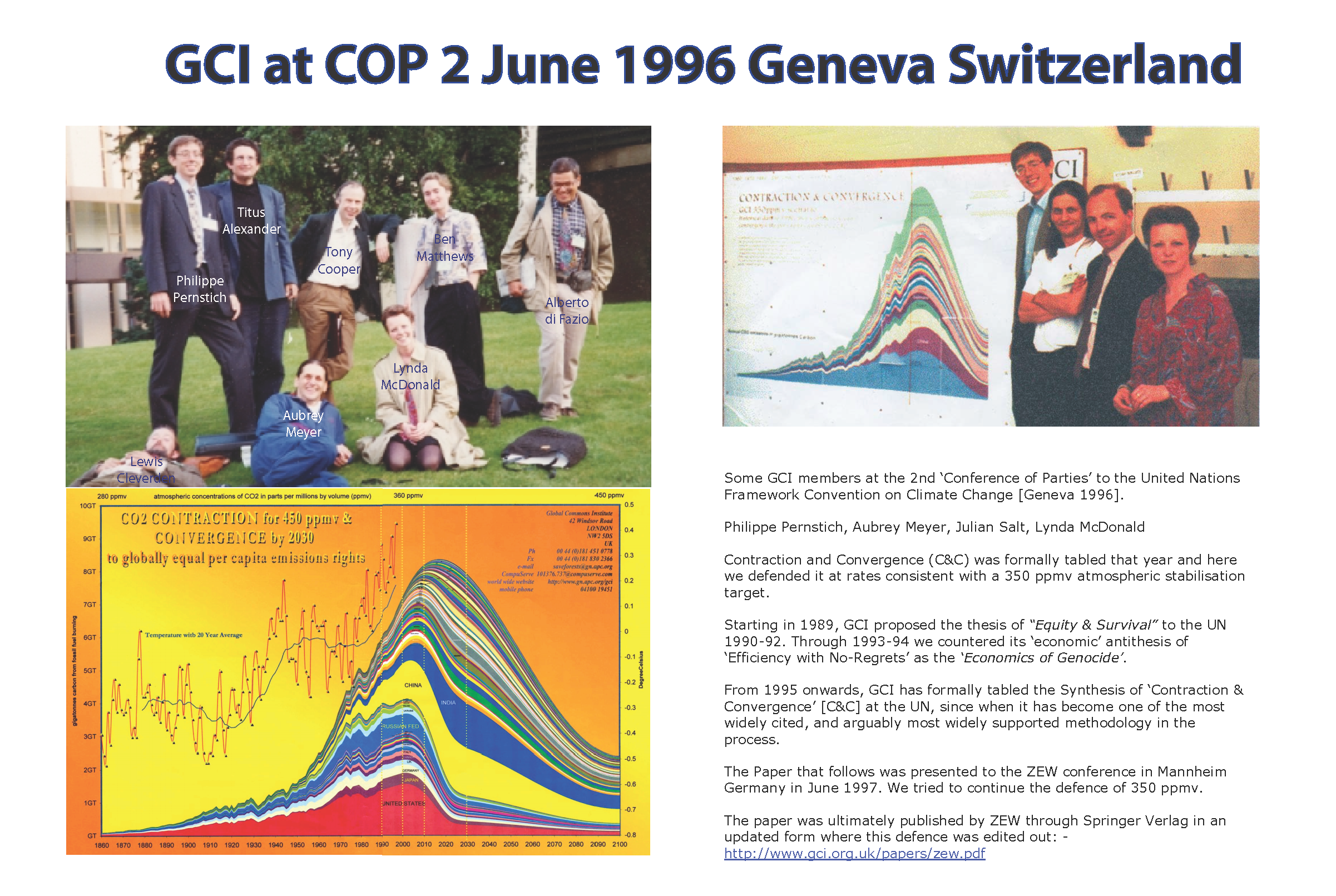
Encouraged by the growing political recognition of this imperative, GCI has devised a greenhouse gas abatement methodology based on "Equity and Survival" . We call it "Contraction and Convergence". Early results of this were published to good effect at the Second Conference of the Parties (COP2) in 1996 and these have been distributed widely since then. Subsequently, the C&C campaign has received widespread support from many quarters (see list of references). To demonstrate the procedure, an all country graphic covering the period 1860 to 2100 was compiled as a demonstration example. It shows the history of fossil fuel consumption using data from Carbon Dioxide Information Analysis Centre (CDIAC). And it also shows a future budget of suggested "CO2 Emissions Entitlements" consistent with an outcome of CO2 concentrations in the atmosphere of 450 parts per million by volume (ppmv) by the year 2100.
This is "Contraction". Contraction of CO2 output is the imperative for ecological survival. We observe that such a global consumption path is less dangerous than a path with an outcome of 550 ppmv, but do not wish to imply that we regard the 450 ppmv as being without dangers. We are already taking substantial damages at the present concentrations of around 360 ppmv.
But the budget also distributes available future entitlements to emit CO2 so that they are equalised on a per capita basis globally by - in this example - 2045, the year of the UN Centenary. This is "Convergence" and convergence is the political equity imperative. We consider that a failure to face and secure a global commitment of this kind will result in a perpetual stalemate in the international political process to the extent that the agreement and delivery of global abatement targets will become less and less possible. This view has been strongly reinforced by the snail-like progress of negotiations since COP2 and the extremely limited achievments at Kyoto.
"Contraction and Convergence" is intended to show how to shape a global GHG abatement strategy so as to solve the political and ecological double-jeopardy of climate change. Below is a simplified version.
The graphic below shows our assumptions regarding future population growth in the budget above.
If "Contraction and Convergence" is adopted as the tool for managing CO2 and other greenhouse gases (GHG), there will be a transition to a point (convergence) where future entitlements to emit will have become proportional to population. Forecast of population may assume critical importance and be the subject of negotiation. However, it could be counter-productive to create an incentive for countries to increase their share of the global emissions budget through population growth. We suggest that a starting position should be that Annex One Countries are treated as stable from 2000 forward, and that Non-Annex One Countries are treated as stable from the "Convergence" year forward (in this case 2045). This is portrayed in the graphic above using UN Medium fertility projections for Non-Annex One Countries. We are not here implying or advocating population policy per se.
Before going on to assess which Contraction Budget and which Convergence Date to select, we consider the data provided by the IPCC climate modelers with regard to future scenarios for carbon emissions.
IPCC have published scenarios for different atmospheric GHG concentration levels resulting from different CO2 emissions scenarios, as in the graph below. The scenarios run through years 1990 to 2500 and are expressed in gigatonnes carbon (GTC) from CO2 annually on the left-hand axis. The accumulated emissions (integrals), between 1990 and 2100 only, are summarised in the top right hand corner of the graphic. These are also expressed in GTC. The atmospheric CO2 concentration curves are not shown, but in each case stabilisation occurs after the respective emissions contraction path of each has completed.
The integrals quoted in the right-hand corner of the graphic are obtained from the data series supplied to us by IPCC. They are different from the integrals published by IPCC in their table which follows. IPCC's ranges for accumulated emissions against atmospheric concentration curves are in the table below.
| atmospheric concentration of CO2 expressed in parts per million by volume (ppmv) | ranges of accumulated CO2 emissions expressed in gigatonnes carbon (GTC) |
| 350 | 300 to 430 |
| 450 | 630 to 650 |
| 550 | 870 to 890 |
| 650 | 1030 to 1190 |
| 750 | 1200 to 1300 |
Now we proportion these suggested future emissions paths and their integrals with past emissions. This seems important as most of the IPCC's future projections are - in GCI's judgement - unrealistically carbon-dependent. Just for the 350ppmv scenario, future atmospheric loading would be above an average of 3 to 4 gigatonnes annually for the next 100 years, i.e. the integral would be more than twice the integral emitted since the beginning of industrialisation.
The next graphic below adds these past emissions from 1860 until 1990 and is represented by the black curve on the left hand side. The integral of these past emissions is 212 GTC with an annual emissions rate rising to more than six gigatonnes annually.
It is necessary to point out that IPCC's "S" scenarios are for CO2 emissions per se and should therefore sensibly be regarded as inclusive of any emissions from deforestation. Next to this, GCI's scenario and distributional modelling under "Contraction and Convergence" are for CO2 emissions from fossil fuel burning only, as we do not know what assumptions to make about the distribution of the arrest of deforestation although its arrest per se is necessary for emissions avoided and other ecological reasons.
Globally we are already taking significant damages as a result of altered weather patterns associated with this record. As a result of this integral - i.e. even minus all future emissions - the effect of this historic loading will increase the forcing of adverse climate changes well into next century. This suggests that a change away from this emissions trend as soon as possible is the only prudent option. Prevention is better than a cure which may not even exist.
Even the future range of integrals for 350ppmv (300 - 430 GTC) embraces twice the amount already emitted. This alone clearly augurs an increased rate and intensity of damages. In spite of this the IPCC declared this - its most stringent future abatement path - to be '"ludicrous" because of the 'apparent' but actually quite specious requirement for negative emissions. (We comment further on this particular dispute below in the section "Same Integrals - Different Curves - Accelerated Response").
Going ludicrous in the other direction however, the IPCC saw fit to model scenarios which explored the theoretical possibility of emissions paths to 550, 650, 750 and 1,000 ppmv CO2. These are constantly represented in charts three, four, five and six. They heroically span a period of 500 years into the future. In fact the 1000 ppmv scenario embraces an integral of an additional nearly 1.5 trillions tonnes of carbon emissions to the atmosphere just for the first hundred years, nearly six times the amount emitted so far. The integral for the entire 500 year period is nearly 4 trillion tonnes.
The damage implications of such a scenario represents a new element of irresponsibility in the IPCC which is quite surprising and unwelcome.
These are the two main questions that arise once the twin-policy approach is accepted in principle. We will address 'which budget?' first, as the imperative of convergence only arises as a derivative of the imperative of contraction even if in turn, contraction is only practically achievable once global convergence has been accepted, agreed and configured.
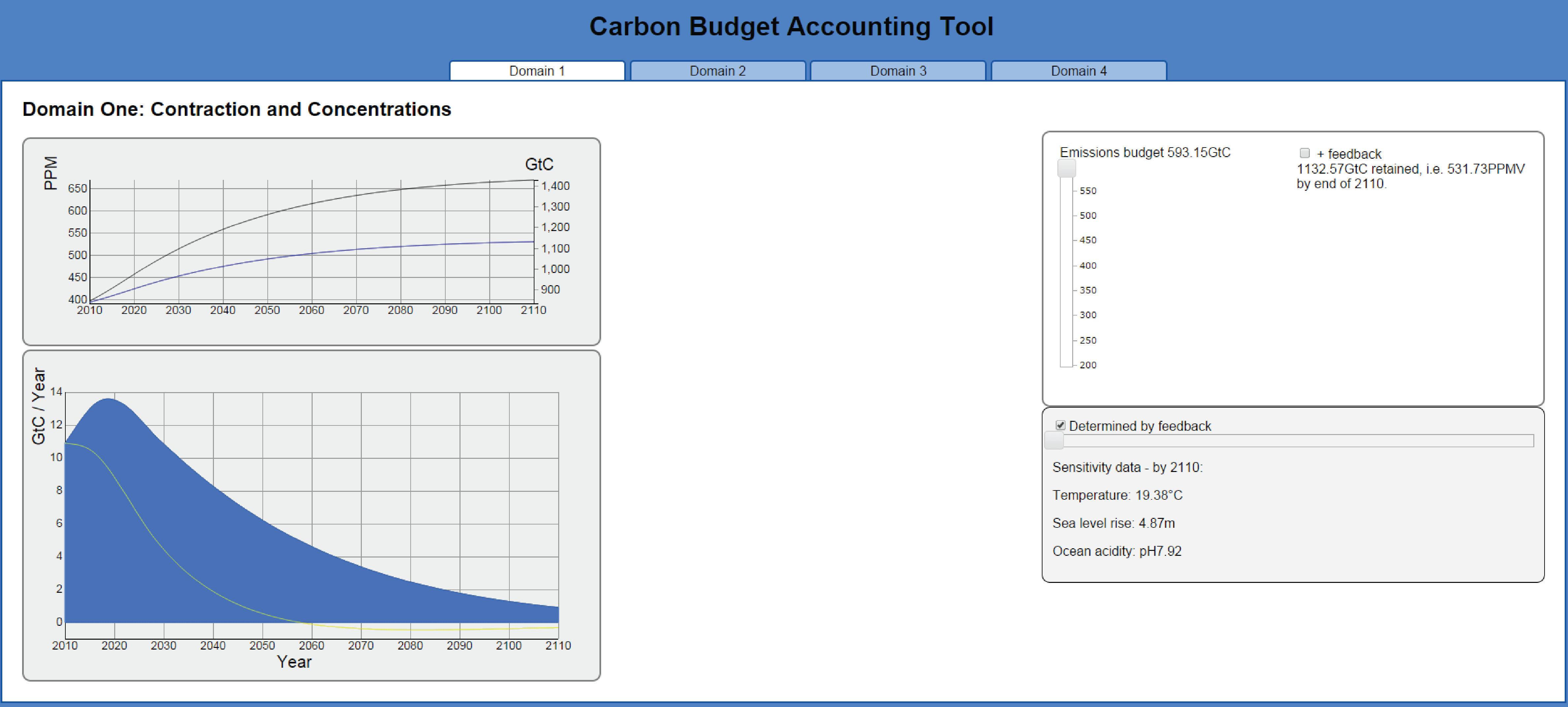
The budget should be 'risk-averse'. It should seek to keep atmospheric GHG concentrations as near to present levels as it is possible to do. We are already taking significant damage from the accumulated CO2 emissions from fossil fuel burning between 1860 and 1990. It should be constantly remembered that atmospheric concentrations (not shown in the graphs) theoretically stabilise only decades to centuries after contraction of emissions has been completed. Also, most known feedback mechanisms are not modelled into these runs. And while their interactive effects on climate forcing are still too complex to simulate in the models, the feedback signs are predominantly assumed positive - i.e. giving increased warming.
Put simply, the curves are drawn against necessarily simplified and very incomplete interpretations of how the climate system may behave under the impact of GHG emissions, should they continue. Furthermore, these are CO2 indicators only - in other words all other GHGs are omitted. Minus any interactions and feedbacks, the equivalent net heating effect of the other GHGs could be around an extra 25%. For CO2, IPCC suggests just for the 450 and 650 curves, temperature rises above pre-industrial levels of between 1.5 and 4.5 C. So it is crucial to temper any sense of certainty or security implied by the IPCC's figures. They are heroic long-range projections. They are cumulative emissions budgets over a period of 500 years into the future with the IPCC having presented integrals for the first 100 years only. Moreover, already by 2100, the 550, 650, 750 and 1000 ppmv budgets, are each delivering an annual CO2 output greater than output in 1990. This is the equivalent of delaying serious global contraction policy by a century. Such a delay carries unjustifiably high damage risks. Already by 2100, even the 350 ppmv budget contemplates around two times the amount of emissions accumulated between 1860 and 1990. In the light of the rising impact trends apparently associated with just this history, even the budget returning us to 350 via 400 ppmv seems fraught with risks. A 280 ppmv goal may yet prove necessary.
So the question of 'which budget' is best dealt with in the following manner. Anything higher than 450 ppmv should be regarded strictly as propaganda originating from the commercial and industrial lobby, particularly the fossil fuel sector, in other words from people who remain opposed to any change to the status quo. Moreover, faced with the risks of irreversibility and the unknowns about how close to thresholds of irreversibility we may already be, it is also clearly absurd to decide specifically 'the budget' as though we were going to decide it and then adhere to it come hell and high-water. The initially agreed budget will inevitably have to be reviewed and revised (we suggest at a maximum five yearly interval). In other words, if we started out in Kyoto with a global agreement to follow "Contraction and Convergence" on a 450 ppmv path, we might well have had to revise this downwards to a 350 ppmv path or less, even if the evidence of damages and human causation continued to come in only at the rate already established.
Knowing this, it makes no sense at all to set out for 550 ppmv or above, because we can already see that a subsequent revision downwards to 350/450 ppmv paths would prove politically impossible because the necessary contraction rates would prove too high, and possibly for ecological reasons as well because uncontrollable feedbacks might be activated.
The historical argument of equity for its own sake - here "convergence" per se - never gained enough force by itself to more than slightly mitigate the socially polarising tendencies of industrial and monetary laissez faire. However, the argument of equity for survival is unavoidable and urgent once the imperative of observing global limits to GHG emissions is recognised. A global cap on these will not be agreed widely enough unless correcting the global maldistribution of present and future energy use is accepted and enacted by formal agreement as well. If for example the scenario chosen is 450 ppmv (later revised to 350 ppmv), ie contraction completing in 2100 (or as soon as 2045), we feel that 2045 - the UN Centenary - is a powerful symbolic date to which the "convergence" programme should be focused. The politics of saving the planet is going to need all the help it can get.
If any industrial or industrialising countries were to continue pursuit of ecological and political roulette intent on avoiding contraction or the linkage of convergence to contraction, meaningful international agreement on abatement strategy would - in our judgement - fail to materialise and contraction per se will become unachievable and major damages will become an inevitability. We will probably enter an era in which mitigation and abatement policy intentions will become irrelevant as progressively unstoppable momentum takes us towards the irreversibility of major equilibrium shifts in the system as a whole.
In this time leading up to Kyoto the paramount need is to break the deadlock in the global negotiations so that the US demand for commitments to emissions restraint from everyone is accepted but on conditions which clearly exact from them a reciprocal commitment to some process of convergence inside the limits which a global cap on emissions represents.
Seeking this, we see the possibility of an alliance of some major Annex One and Non-Annex One Countries and possibly AOSIS becoming committed to a process of "Contraction and Convergence" ending deadlock between Annex One and Non-Annex One countries of the last six years and winning the first stage of the global campaign to adopt the strategy of "Contraction and Convergence" by Kyoto. We do not believe that any party to the UNFCCC can seriously or successfully oppose this linkage if this formation emerges.
If an effective global abatement strategy does not emerge by the Third Conference of the Parties (COP3) in Kyoto, this psychology of 'adaptation' (rather than 'prevention' and 'mitigation') will seriously begin to take root as the default option, with millions of people being put at profound risk.
At this time, the industrial policy attitude is still to regard abatement as the greater cost against the lesser cost of mass death and damages due to human and industrially induced climate change. If these circum-stances persist, it may well consolidate a general strategic orientation favouring adaptation. IPCC's Second Assessment Report (SAR) Working Group Three (WG3) already presented this absurd abatement-cost to damage and mortality cost ratio. GCI does not believe any sensible policy can emerge - or should even be countenanced - which intentionally or unintentionally runs such risks.
Return to Contents
Return to GCI home page